
How to Make Vasilopita: Greek New Year’s Cake!
Want to Learn How to Make Vasilopita? Vasilopita is the most traditional Greek cake eaten during the holidays. More specifically, Vasilopita is made one or two days before the end of the year and enjoyed with the whole family on New Year’s Day.
Join the My Cretan Recipe Facebook group.
They say that every Greek cook has their recipe for Vasilopita, and that is true! In this post, I will share with you my own Vasilopita recipe.

This is a delicious Cretan recipe that has been passed from generation to generation in my family.
Read on and learn how to make a traditional Vasilopita from Crete!
Different versions of Vasilopita

Vasilopita (Βασιλόπιτα, meaning (Saint) Basil’s pie or Cake) is a spongy, delicious cake or bread made in Greece and in other areas of the Balkans, which hides a small coin or trinket that is thought to grant good luck to whoever receives it inside their piece of cake.
Vasilopita is related to Saint Basil’s Day (January 1st), locally known as Agios Vasilis. And the fun part of this tradition is that there are as many different recipes as families in the country!

Everyone claims to have their secret to make it special. For instance, some families make Politiki Vasilopita, similar to tsoureki with a dough similar to brioche.
Other traditions want Vasilopita to be made from a custard base instead of regular dough, which is known as galatopita (milk cake).
My own Cretan Vasilopita
My Vasilopita is similar to a sponge cake, something like an Italian Pan di Spagna or even Torta Margherita, also known as Bizcocho in Spain or Bizcochuelo in Latin America, but with a heavy butter scent.
Curious Fact: The cake is also known as Chronópita, (Χρονόπιτα) this comes from the word χρόνος (chrónos – time) and πίτα: (píta – pie) meaning “New Year’s pie”.
How I make it


I start by separating the eggs, because this cake gets its beautiful lightness from a well-made meringue. The egg whites go into a large, clean bowl with a pinch of salt and are whipped until they hold firm, glossy peaks. I set this aside and move on to the base of the cake.


I cream the softened butter with the sugar until the mixture looks pale and fluffy. This step is important—it’s what gives the vasilopita its rich, tender crumb.
Then I add the egg yolks one at a time, mixing well after each addition so everything stays smooth and emulsified.

Once the yolks are fully incorporated, I pour in the condensed milk, the brandy (or cognac), the vanilla, and the citrus zest, which instantly fills the kitchen with that unmistakable New Year aroma.
Next, I gradually fold in the self-raising flour. At this point, I stop using the mixer completely, and I gently fold the meringue into the batter in batches, using a spatula and light, sweeping motions.

The goal is to keep as much air in the mixture as possible so the cake bakes up tall and fluffy.
I pour the batter into a buttered and floured cake pan, making sure it’s evenly spread, and carefully tuck the wrapped coin into the batter.

The cake then goes into a preheated oven, where it bakes until golden, risen, and fragrant, and a skewer inserted in the center comes out clean.
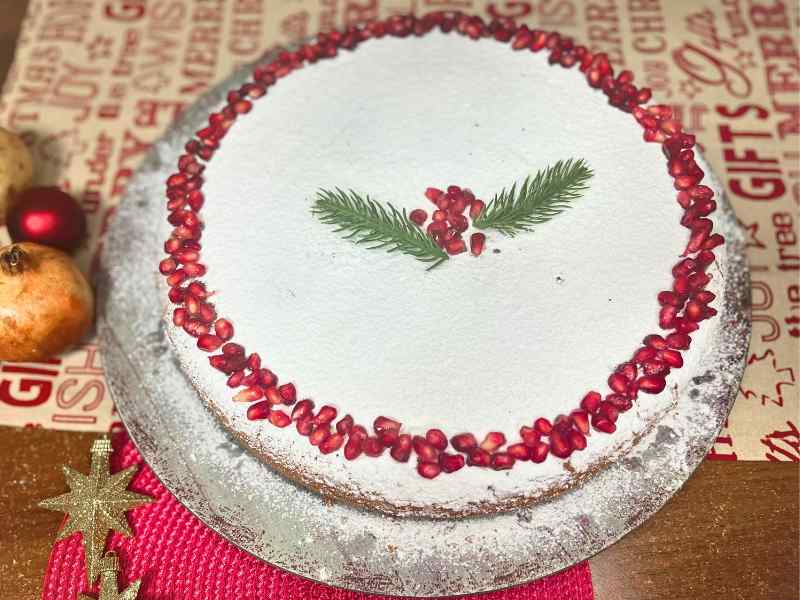
Once baked, I let the vasilopita cool completely in the pan. Just before serving, I dust the top generously with icing sugar—simple, traditional, and exactly how this festive cake should be enjoyed. Sometimes, I add a pop of color with pomegranate seeds!

The family ritual of cutting the Vasilopita
Depending on each family tradition, Vasilopita can be cut and shared at midnight on New Year’s Eve or even on the 1st of January, in the morning.
No matter which tradition the family follows, when the cake is cut, it is believed to bless the whole household as well as to bring good luck for the year that has just begun.


Usually, the sign of the cross is etched with a knife on top of the cake, while each member of the family receives a slice by order of age: from the eldest to the youngest.
We usually make the Vasilopita fairly big (in fact, we use a 32-cm cake pan) because, according to some family traditions, the first slices of vasilopita go to the Virgin, Saint Basil, or other saints, the household, the poor, or even the Kallikantzaroi!

That coin (or flouri) used to be a valuable one in the past, but today it has been replaced by a regular coin or token.
History behind the Vasilopita tradition
The tradition around Vasilopita resembles Western European celebrations of the Twelfth Night and even Epiphany. However, for us in Greece, Vasilopita is closely related to the legend of Basil of Caesarea, or Agios Vasilis. And it is a fascinating legend…
There are, of course, other versions of this legend, and you can find out more here as well.

It is said that Basil called on the Roman citizens in Caesarea to raise a ransom to put an end to the siege of the city. Everyone would give whatever valuable object in their possession.
It is said that the enemy did not collect the ransom and simply put an end to the siege without any payment. It was Basil’s task to return the valuables to the citizens, but he didn’t know what belonged to each family. So, he baked all of the objects into loaves of bread and distributed the bread in town.
Saint Basil’s miracle then occurred when each family received their exact share.
Vasilopita in other Balkan countries

It is a curious fact that in different areas of the Balkans, the tradition of hiding a coin in a cake exists, especially during the holidays, but it has nothing to do with Saint Basil.
Some of the countries that have a similar cake are Albania, where the cake is known as pitta and is eaten by Christians and Muslims. In Ukraine, the cake is called pirog, while in Romania and Serbia, it is known as česnica, and it is shared during Christmas. Bulgarians, instead, share a similar cake known as pogača or pagacha on New Year.
>> You have already learned how to make Vasilopita and want to check out more Holiday sweets?
Discover how to make Melomakarona and Kourabiedes.

Greek New Year’s Vasilopita Cake
Equipment
- 1 Stand mixer optional
Ingredients
- 6 eggs
- 250 grams unsalted butter
- 125 grams margarine
- 400-500 grams sugar
- 1 cup condensed milk (for better flavor, we use condensed milk, which you can replace with regular milk)
- 60 ml brandy or cognac (I recommend Greek Metaxa or Cretan tsikoudia)
- 500 grams self-raising flour
- ½ tsp vanilla extract (liquid or powder)
- 1 orange (or lemon) zest
- 1 pinch salt
- icing sugar to decorate
- 1 small coin wrapped in aluminum foil
- pomegranate seeds to decorate (optional)
Instructions
- Separate the whites from the yolks, set the yolks aside, and put the 6 whites in a big bowl with a pinch of salt.
- With a mixer, using high speed, mix until you obtain a firm meringue (when you turn your whisk upside down, the peaks will hold), and set the meringue aside.
- Take another bowl and mix the butter (which you have left out of the refrigerator for a few hours) and the sugar.
- Add the yolks one by one and keep mixing until you have incorporated them. Only now, incorporate the milk, the brandy, the vanilla, and the lemon zest.
- Add the flour little by little.
- Once all these elements are incorporated into a soft batter, start adding the meringue.
- Do not use the mixer to prevent the meringue from softening. Use a rubber spatula or a wooden spoon, little by little and with soft movements to also incorporate some air.
- Use a 32 cm cake pan that has previously been buttered and floured. Add the batter to the cake mold and the small coin that you have previously wrapped in aluminum foil.
- Bake in a preheated oven at 170 °C for 45 to 50 minutes.
- Once out of the oven, let it cool and decorate with icing sugar on top.
Notes
- This is a rich, buttery, and fairly high-calorie cake.
- The ideal serving size would be 12–16 slices, each around 450–600 kcal, depending on slice size.
Nutrition
Have you ever tried Vasilopita?
Did you get the coin? Let me know!
Pin for Later!
Greek Vasilopita Recipe that’s Tasty and Super Easy!


MORE HOLIDAY IDEAS


Apostolis (Tolis)
Born and raised in Chania, Apostolis is a proud Cretan and devoted foodie with a passion for his island’s flavors. He brings a wealth of local knowledge, from forgotten cooking techniques to rare village recipes, always striving to preserve Crete’s culinary heritage. As the main voice behind most of our Cretan recipes, he prefers to stay behind the scenes, letting the food and its stories take center stage—always real, always authentic.
>> Interested in learning to cook in Crete, or discovering all of the top spots to eat in Chania and around the island? Book a food tour or plan your trip with me.


One Comment
John Papas
I’ve used your recipe last year and it was awesome . I will be printing it out this year to keep and make it again for new year’s